


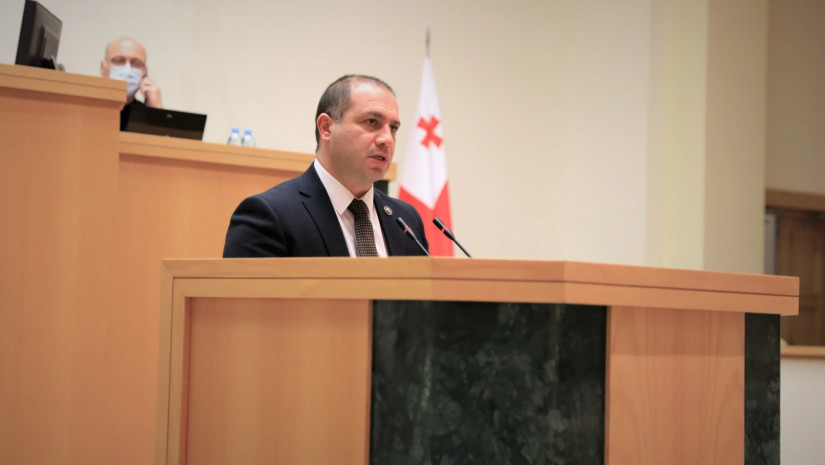
The Georgian Education Minister, Givi Mikanadze, presented the government’s ongoing general education reform while speaking in Parliament during an interpellation session.
“The goal of the reform is to enable young people who graduate from school to realize themselves, create economic wealth, and become citizens actively involved in the development of the country. It is important for us to form a generation that is state-minded, has appropriate values, and cares both about personal development and the well-being of society,” Mikanadze said.
According to the minister, the reform includes updated curricula and textbooks, teacher support programs, and the creation of a safe and inclusive educational environment.
A significant part of the reform concerns the updating of school textbooks. Mikanadze described the introduction of the “one textbook” principle as a major systemic change aimed at ensuring uniform quality standards across the country.
“In our view, it is the direct responsibility of the state to ensure that all students, regardless of their place of residence or social status, have access to quality, academically sound, and modern educational resources,” he said.
According to the minister, existing textbooks were reviewed before the reform process began, while experienced authors, sector specialists, universities, psychologists, and practicing teachers were involved in creating new educational materials.
“The new textbooks will not be developed in a closed format. Instead, all textbooks entering schools from September 15 will undergo a piloting stage involving teachers and parents directly in the educational process,” he said.
Responding to criticism that the “one textbook” approach could limit diversity, the minister said teachers would still retain full academic freedom to use additional materials tailored to students’ interests and needs.
The minister also spoke about the introduction of a “profile-oriented” approach in grades 10 and 11, aimed at aligning education more closely with students’ interests and future professional choices.
According to Mikanadze, students should receive core foundational knowledge at the basic level, while upper secondary education should focus more on specialized subjects connected to future university studies or careers.
“The secondary school level and higher educational institutions should be interconnected in such a way that parents do not need to spend additional resources on preparation. Entrance exams for higher education will fully correspond to the curriculum taught in the 11th grade,” he said.
Mikanadze also emphasized closer integration between general and vocational education. For the first time this year, applicants registering for exams were able to select vocational colleges alongside universities.
“After the exams are completed, students will be able to make a final decision based on their interests and results,” he noted.
Regarding the 12th grade, Mikanadze stated that it will remain optional and that schools will provide instruction even if only one student chooses to continue.
“We will spend all necessary resources so that even one applicant has access to education. Students and parents are free in this choice,” he said.
The minister also announced that beginning this school year, first-, seventh-, and tenth-grade students will receive new textbooks in subjects including Georgian language, history, geography, chemistry, biology, physics, and mathematics.
According to him, the new textbooks will be lighter and divided into semester-based volumes in order to reduce the weight of students’ school bags.
“We are refusing thick textbooks and introducing a new principle by switching to semester textbooks. Some books will be printed in three or four parts to lighten students’ bags. In this regard, we also care about our children’s health,” Mikanadze stated.